What Knife Do I Need? Types, Steel & Knife Blocks Guide
Maybe your go-to knife isn't cutting like it used to. Or perhaps you've opened the drawer and realised half the knives in there barely get used. Either way, replacing a knife can quickly raise a bigger question: what knives do you actually need?
This guide breaks down the different types of knives, what each is best used for, and the differences between forged and stamped construction, Japanese, German, and stainless steel. We'll also cover knife sets and blocks, plus our picks for different cooking styles and budgets, so you can decide what's worth adding to your kitchen.

At a Glance: Every Knife Type
You don't need every knife in the drawer. Some earn their place in everyday meal prep, while others are worth having only if you regularly tackle a particular job. Here's the quick version before we get into the details.
A Quick Guide to Every Knife Type
- Chef's knife: chopping, slicing and dicing. The knife you'll probably use most. Suited for everyday use.
- Santoku knife: precise slicing, dicing and mincing, especially vegetables. Suited for everyday use.
- Utility knife: mid-sized jobs too big for a paring knife but too small for a chef's knife. Suited for everyday use.
- Paring knife: peeling, trimming and small, precise cuts. Suited for everyday use.
- Bread knife: cutting crusty bread and other soft-centred foods without crushing them. Suited for everyday use.
- Kitchen shears: cutting herbs and poultry, plus opening packaging. Suited for everyday use.
- Carving knife: slicing roasts and larger cuts of cooked meat. Suited for occasional use.
- Filleting knife: boning and filleting fish with greater control. Suited for occasional use.
- Cleaver: chopping through meat, joints and bone. Suited for occasional use.
What Are the Different Types of Knives?
Chef knife
Best for: Chopping, slicing and dicing. The knife you'll probably use most.
What is it: A chef's knife, also known as a cook's knife, is one of the most versatile knives in the kitchen. Across House's range, chef's knife blades commonly range from 15 to 25cm, with 20cm being a popular size. The broad blade curves towards a pointed tip, making it well suited to a rocking motion on the cutting board.
When to use it: Reach for a chef's knife when slicing, dicing or mincing meat, fruit, vegetables and herbs. The larger blade is particularly handy for foods such as potatoes, pumpkin, and carrots, while a smaller chef's knife gives you greater control for finer vegetable prep.
Utility knife
Best for: Mid-sized jobs too big for a paring knife but too small for a chef's knife.
What is it: Think of the utility knife as the chef's knife's smaller sibling. Across House's range, utility knife blades typically run from 11 to 15cm, making them smaller and slimmer than a chef's knife and easier to control when a full-sized blade feels like more knife than the job requires.
When to use it: A utility knife is useful for slicing meats and cheeses, chopping smaller fruits and vegetables such as peaches or broccoli, and preparing sandwiches and smaller breads.
Paring knife
Best for: Peeling, trimming and small, precise cuts.
What is it: Also known as a peeling knife, a paring knife has a short blade that gives you greater control for detailed prep. Most paring knives across House's range have a compact 9cm blade, giving you greater control for detailed prep where a larger knife would get in the way.
When to use it: Use a paring knife for peeling, trimming and coring fruit and vegetables, along with precision jobs such as preparing small garnishes, deveining prawns or skinning mushrooms.
Santoku knife
Best for: Precise slicing, dicing and mincing, especially vegetables.
What is it: Originating in Japan, the santoku knife is an all-purpose knife with a broad blade and relatively flat cutting edge. Across House's range, most santoku blades sit between 15 and 18cm. Many feature hollows or indentations along the blade that can help reduce food sticking as you cut. The broad blade is also handy for scooping chopped ingredients from the board.
When to use it: A santoku can handle many of the same everyday jobs as a chef's knife, particularly slicing, dicing and mincing vegetables, meat and herbs. Its flatter profile lends itself particularly well to an up-and-down chopping action.
Bread knife
Best for: Cutting crusty bread and other soft-centred foods without crushing them.
What is it: A bread knife has a long, serrated blade that cuts through a firm exterior without requiring lots of downward pressure on the softer food underneath. Across House's range, bread knife blades typically run from 20 to 24.5cm.
When to use it: Bread may be the obvious answer, but the serrated edge is useful for plenty of other foods that are firm outside and soft inside. Think crusty loaves, rolls, cakes and ripe tomatoes.
Kitchen shears
Best for: Cutting herbs and poultry, plus opening packaging.
What is it: Kitchen shears are a useful alternative to a knife for jobs that are easier to tackle with a snipping action. Depending on the pair, features can include sturdy blades, shaped handles or mechanisms intended for tougher kitchen prep.
When to use it: Use kitchen shears to snip herbs, trim meat and poultry, cut around joints, and open food packaging. They're particularly handy when a knife and chopping board would make a simple job more fiddly than it needs to be.
Carving knife
Best for: Slicing roasts and larger cuts of cooked meat.
What is it: A carving knife is typically longer and narrower than a chef's knife. The slim profile makes it easier to create long, controlled slices through larger cooked meats. Most carving knives across House's range have a blade around 20cm long.
When to use it: Bring out the carving knife for roast beef, lamb, pork, turkey and other larger cooked cuts when you want clean, even slices rather than shorter chopping motions.
Filleting knife
Best for: Boning and filleting fish with greater control.
What is it: A filleting knife has a long, narrow blade with enough flexibility to work closely around bones and contours. Across House's range, filleting knife blades typically run from around 18 to 20cm. That flexibility separates it from the broader, more rigid knives used for general chopping.
When to use it: Use a filleting knife to remove fish skin and bones, portion fillets and make the long, controlled cuts needed when preparing fish. It can also help with other delicate meat-preparation tasks where a flexible blade gives you better control.
Cleaver
Best for: Chopping through meat, joints and bone.
What is it: A cleaver has a wide, heavy blade built for jobs that would be unsuitable for a finer chef's or santoku knife. Its weight helps provide the force needed for heavier chopping.
When to use it: A cleaver is useful for portioning meat and poultry and tackling joints, bones and other heavy-duty preparation. The broad blade can also handle larger, dense vegetables, though exactly what a cleaver can tackle depends on its construction.
Types of Knife Manufacturing
Kitchen knives are generally made using one of two methods: forged or stamped. Forged knives tend to be heavier, while stamped knives are often lighter, but the manufacturing method alone doesn't determine how well a knife will perform. How the knife feels and balances in your hand matters too.
Forged steel knives
Forged knives are made from a single piece of steel that is heated and shaped before being hardened, tempered, ground and sharpened. The process generally produces a heavier knife, which some cooks prefer for its substantial feel and for cutting tougher foods.
Forged knives are often more expensive because of the manufacturing involved, but that doesn't automatically make them the better choice. Independent testing by CHOICE found that forged knives didn't necessarily outperform stamped knives and recommends considering how a knife feels in your hand when choosing between them.
Stamped steel knives
Stamped knife blades are cut from a sheet of steel before being ground, polished and sharpened. The manufacturing process is generally quicker, and stamped knives are often lighter than their forged counterparts, which can actually be an advantage if you prefer a lighter knife.
Rather than assuming one manufacturing method is better, consider the knife's weight, balance and comfort in your hand, along with the quality of the blade itself. CHOICE specifically highlights balance and comfort as important considerations when choosing a kitchen knife.
Types of Knife Blade Materials
The steel used in a knife can affect how sharp an edge it can take, how long that edge lasts and how much care it needs. Japanese, German and general-purpose stainless steels each have different characteristics, so the right choice comes down to how you like to cook and maintain your knives.

Japanese steel knives
Japanese steel is commonly associated with harder, thinner blades that can take a very fine edge. House's Japanese knife selection includes Global and Shun, with both ranges covering everyday chef's and Santoku knives as well as more specialised blades.
Japanese knives can be a good fit if you value precision and a fine cutting edge. Because harder steels can be more susceptible to chipping, use them with appropriate chopping boards and care for them according to the manufacturer's instructions.
German steel knives
German steel knives are generally associated with a sturdy, more forgiving blade and a little more weight in the hand. They can be a good choice for everyday chopping, slicing and heavier preparation.
Compared with harder Japanese-style blades, German steel knives can suit cooks who prefer a more substantial feel and a sturdy blade for regular kitchen prep.
Stainless steel knives
Stainless steel is widely used for everyday kitchen knives because it offers a practical balance of cutting performance, durability and resistance to rust and staining. Baccarat's extensive knife range is a good example of stainless steel knives made for regular home use.
Stainless steel still needs proper care. Hand washing, drying the blade after use, and regular honing or sharpening will help maintain the cutting edge and condition of the knife.
How the Three Steel Types Compare
Japanese steel: generally high edge retention with a fine cutting edge. Sharpens quickly but needs it more often. Hand wash and dry promptly.
- Example House range: Global, Shun.
German steel: moderate to high edge retention. Generally more forgiving to maintain. Hand wash and dry promptly.
- Example House range: Wüsthof.
Stainless steel (general): edge retention varies by steel and hardness. Needs regular honing and periodic sharpening. Rust- and stain-resistant; hand washing recommended.
- Example House range: Baccarat.
Which Knife is Right for Me?
The right knife collection depends less on how many knives you own and more on the jobs you regularly do in the kitchen. For most home cooks, a chef's knife or Santoku, a utility knife, a paring knife, and a bread knife will cover most everyday prep.
If you're starting from scratch, a knife set can be an easy way to cover the essentials in one purchase. A 5- to 7-piece set will typically give you a useful mix of everyday and more specialised knives, often with a block or other storage included.
If you already know which knives you reach for most, building your collection one piece at a time can make more sense. Start with a versatile chef's knife or Santoku knife, then add knives that match how you cook.
Buy a Starter Set or Build Your Own?
- Starter block set: best for a first kitchen or anyone who wants the essentials sorted in one purchase. Typically 5 to 7 pieces.
- Build your own: best for anyone who knows which knives they use and wants to upgrade or add pieces individually. Typically 1 to 3 pieces at a time.
Which knives suit the way you cook?
Occasional cook
- Needs a few versatile knives for simple meals and basic prep.
Good starting point: chef's or santoku knife, paring knife and bread knife.
Everyday cook
- Needs everyday essentials plus a little more flexibility for different ingredients.
Good starting point: chef's or santoku knife, utility, paring and bread knife, or a 5 to 7 piece set.
Confident cook
- Needs core knives plus specialist blades chosen around the food they regularly prepare.
Good starting point: build your own collection with carving, filleting or cleaver options as needed.
Look for a combination that includes most of the knives you'll actually use rather than choosing a larger set simply because it has more You can also browse House's knife blocks and sets if you'd prefer to start with a coordinated collection.
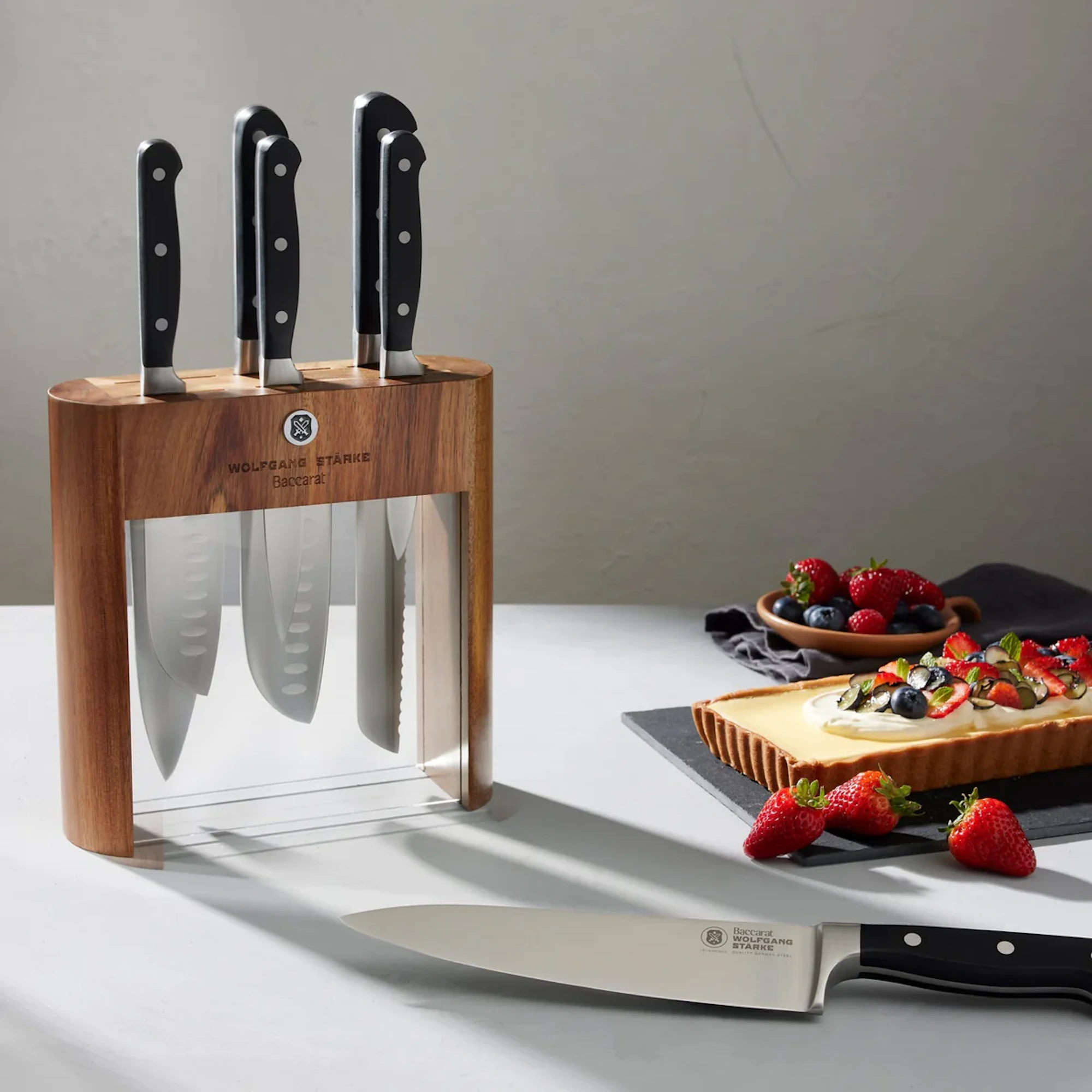
Choosing a Knife Block
A good knife block should have enough space for the knives you actually use while keeping the blades safely stored and protected between uses. Traditional wooden blocks, magnetic blocks and stone-effect designs all do the same basic job, but differ in capacity, appearance and how flexibly you can arrange your knives.
How many knife block slots do you need?
Start with your knives, not the block size. If you're building your first collection, use the starter-set guide above as a starting point rather than buying a large block with slots you're unlikely to fill.
If you already own your essential knives, count what you have and leave room for any specialist knife you genuinely expect to add. Fixed-slot blocks work well for a defined collection, while magnetic designs can offer more flexibility if your knives vary in size or you prefer to build your collection gradually.
Knife block or loose drawer?
A knife block or magnetic storage system not only keeps the benchtop tidy, but also keeps sharp blades separated and protected, rather than letting them knock against other utensils and damage the cutting edge.
It can also be safer than keeping unprotected knives loose in a drawer, where reaching among other utensils creates an unnecessary risk of contact with a sharp blade. If you prefer drawer storage, use individual blade guards or another purpose-made knife storage solution rather than leaving blades exposed.
Which Knife Block Style Fits Your Kitchen
- Traditional block: wood. Typical capacity is 7 to 9 pieces. Wipe clean and keep dry.
- Magnetic block: wood or acrylic with a magnetic strip. Typical capacity is 5 to 7 pieces, with more flexible sizing. Wipe clean.
- Stone or terrazzo block: stone-effect composite. Typical capacity is 5 to 7 pieces. Wipe clean

Our picks based on your preferences
The best knife range isn't necessarily the most expensive one. It comes down to what matters most to you, from everyday versatility and storage to blade feel, construction and the style of knife you prefer using.
House carries a wide range of knife varieties at different price points, so rather than picking one overall winner, we've matched some of our standouts to the preferences they suit best.
- Looking for an everyday hero: Baccarat SABRE, forged German stainless steel, wood or magnetic block options. A versatile everyday range backed by Baccarat's lifetime guarantee. Verified buyer Enver A. summed it up as a "quality product and great price."
- Looking for an Australian-designed option: Furi Pro, stainless steel with East-meets-West blade geometry, stone, terrazzo or magnetic block options. Australian-designed with distinctive storage options. Reviewer Amanda M. praised the knives as "well balanced" and "very sharp."
- Looking for premium German steel: Baccarat WOLFGANG STARKE, German stainless steel, individual knives and block sets. A broad range of blade types with a more substantial feel. Reviewer Jeremy B. described his set as "well made" with a "solid feel in the hand."
- Looking for premium Japanese precision: Global or Shun, Japanese steel, individual knives and block sets. A strong choice for cooks who prefer lighter, precise Japanese knives. Global reviewer Danielle J. described hers as "light, sharp, comfortable and easy to use."
These aren't simply four steps up a price ladder. Choose the range that best matches the knives you'll actually use rather than paying for extra pieces that will stay in the block

FAQs
How many kitchen knives do I actually need?
Most home cooks only need three core knives: a chef's knife, a paring knife and a serrated bread knife. From there, you can add more specialised blades based on what you regularly cook. See our starter-set table above for a quick guide to which knives are worth adding and when.
Is a magnetic knife strip as good as a block?
Yes, a good magnetic knife strip can be just as practical as a knife block, provided it holds each knife securely, and the blades aren't knocked against hard surfaces. It can also free up bench space and make your knives easy to see and reach. Compare the storage options in our knife block table above to find the best fit for your kitchen.
Do more expensive knives really cut better?
Often, but not always. CHOICE found that knives with an RRP of $100 or more mostly outperformed cheaper ones in testing, but price alone doesn’t guarantee quality. An $8 chef's knife from Kmart sits in the same category as $199 cook's knives from Global and Wüsthof, yet performs very differently. Look past the price tag to the steel, edge retention and construction covered above before you decide.
What's the difference between a santoku and a chef's knife?
A chef's knife has a curved blade suited to a rocking cutting motion, while a santoku typically has a flatter edge suited to more vertical chopping and slicing. Read our Santoku vs Chef Knives guide for the full comparison.
My knife feels dull, but it's not old: Sharpen or replace?
Sharpen it first. A dull edge doesn't necessarily mean the knife itself needs replacing. Our How to Sharpen a Knife guide covers the different sharpening methods and how to restore the edge.
Does forged or stamped actually matter when I'm buying?
Yes, but forged isn't automatically better. Forged knives tend to be heavier, while stamped knives are generally lighter. As covered above, consider construction alongside blade quality, balance and comfort rather than treating “forged” as a guarantee of quality.
Back to blog